ADC-ICTY Legacy Conference in the Hague – 29 November 2013

The ADC-ICTY Legacy Conference will take place in the Bel Air Hotel, The Hague, on 29 November 2013. The keynote speech will be delivered by H.E. Judge Theodor Meron, ICTY President. Speakers and moderators include The Right Hon. Lord Iain Bonomy, Judge Bakone Justice Moloto, Judge Howard Morrison, as well as renowned Defence Counsel. The conference is organised with the support of the Law Faculty of the Erasmus University Rotterdam.

Courtroom-ICTY

Credit: ICTY

You can follow the ADC-ICTY Legacy Conference on Twitter – follow @ADCICTYLegacy. @ADCICTYLegacy aims at providing information about the conference and the publication that will follow.  On 29 November, they will be live tweeting from the conference for those who are unable to attend. The schedule is available here.

To register for the conference, please click here and for any other information on the conference, please contact Isabel Duesterhoeft at iduesterhoeft@icty.org.

For information on social media issues relating to the conference, please contact Anna Katulu at akatulu@icty.org.

African Experiences of Youth in Political Violence – Reflections on Zimbabwe

by Paul Bradfield

History tells us that politically motivated violence occurs in every society at some point during its existence. Be it in time of independence or rebellion, young people invariably play a role in perpetrating acts of violence. Indeed, in weak and emerging societies, political leaders sometimes play a subversive role in manipulating and mobilising young people to violently realise and further their own political objectives.

Mobilising youth to commit political violence is not an inherently African problem, but is common in many societies around the world. With the recent elections in Zimbabwe, this post takes a deeper look at the mobilisation of African youth in political violence.

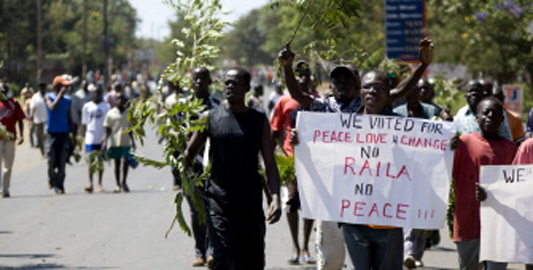
no raila

ODM supporters protest following the 2007 Kenyan elections. (Photo: nipate.com)

Young men and women get involved in violence for diverse and context-specific reasons. The prevailing theme in the commentary on youth and violence is that exclusion and lack of opportunities faced by young people leads to disillusionment and, in some cases, their participation in violence. Unemployment, insufficient educational opportunities, poor governance and social marginalisation can lead to the deep disaffection of youth in society, increasing the likelihood of them resorting to anti-social activity and engagement in violence.

Continue reading

Journée de la justice pénale internationale : la quatrième tentative du 17 juillet 2013.

« La journée de la justice pénale internationale » est, avec « la journée pour la justice sociale », l’une de ces occasions annuelles et universelles qui permettent de communiquer sur un sujet d’intérêt commun. Ces deux journées partagent également, même si leur intitulé ne le précise pas, une vocation internationale (il manque en effet l’adjectif qualificatif « internationale » accolé au substantif « journée »). Bien que sa vocation initiale soit la promotion par diverses formes de communication de la justice pénale internationale, cette journée est aussi l’occasion de dresser un bilan et d’évoquer l’avenir.

C’est d’ailleurs à l’occasion d’un exercice de bilan que la création de cette journée a été décidée. En effet, l’Assemblée des États parties à la Cour pénale internationale, réunie pour la première conférence de révision du Statut de Rome,  a décidé « de célébrer dorénavant le 17 juillet, jour de l’adoption du Statut de Rome en 1998, comme la Journée de la justice pénale internationale » (ICC/RC/11/Decl.1). C’est ainsi que la première journée de la justice pénale internationale fut célébrée, le 17 juillet 2010. Mais il a fallut attendre l’année 2011 pour que l’institutionnalisation de cette journée prenne toute son ampleur. Sous l’impulsion du Greffe de la Cour pénale internationale, plusieurs activités avaient été prévues dans la ville du siège de la Cour, La Haye aux Pays-Bas, alors que le Tribunal pénal pour l’ex-Yougoslavie avaient été associé.

Cette année, quinze ans après l’adoption du Statut de Rome, la journée de la justice pénale internationale n’a visiblement pas la portée souhaitée. En effet, l’universalisme indispensable à ce type d’occasion, souffre sous deux aspects : géographique et matériel. Force est de constater que, géographiquement, la célébration de cette journée demeure limitée, en dehors des quelques États qui soutiennent la cour avec une vivacité permanente. En outre, la journée de la justice pénale internationale n’est pas célébrée par toutes les juridictions pénales internationales. Cette année, seule la Présidence de la Cour pénale internationale a communiqué une déclaration, singulièrement franche, de laquelle peuvent être retenus les éléments suivants :

Continue reading

Bienvenue / Welcome to Beyond The Hague !

(le français suit ci-dessous)

Welcome to BeyondTheHague.com (BTH), our blog about international justice in its many forms.  We all met in The Hague working with the different international institutions and tribunals. Currently, we find ourselves involved or interested in these issues but in very different surroundings in Warsaw, Bunia, Stockholm, Malawi, Nice and Geneva. The idea behind this blog is to provide a space where we can share our thoughts and experiences around international justice in both English and French.

We’re starting things off with posts about Uganda’s new transitional justice policy, that letter from Judge Harhoff at the ICTY, and the controversy over the “massacre” or “genocide” at Volhynia in Poland during WWII. We’d love to hear your comments !

Please help us spread the word by linking to BeyondTheHague.com, our Facebook page, or doing whatever the kids are doing these days on Twitter (@beyondthehague).  And if you want to share your own thoughts on international justice, we’ve set up a Contribute page for guest bloggers.

With our warm regards,

Alex, Manuel, Maria Elena, Marysia, Paul and Peter

—-

Bienvenue sur BeyondTheHague.com (BTH), notre blog sur la Justice internationale sous ses différentes formes. Nous nous sommes tous rencontrés à La Haye, en travaillant au sein de différentes institutions et tribunales internationales. Actuellement, nous restons impliqués ou intéressés par ces mêmes questions, mais depuis des lieux très variés : Varsovie, Bunia, Stockholm, Malawi, Nice et Genève. L’idée derrière ce blog est d’offrir un espace où nous pouvons partager nos réflexions et expériences autour de la Justice internationale en anglais et français.

Nous commençons les choses avec un article portant sur la nouvelle politique de justice transitionnelle en Ouganda, la lettre du Juge Harhoff au TPIY, et le controverse autour du “massacre” ou “génocide” à Volhynia en Pologne pendant la deuxième guerre mondiale. Nous apprécierions lire vos commentaires !

Aidez-nous à passer le mot par un lien vers BeyondTheHague.com, notre page sur Facebook, ou faîtes ce que font les ado ces jours-ci sur Twitter (@beyondthehague).

Si vous souhaitez partager vos propres idées sur la Justice internationale, nous avons mis en place une page de contribution pour blogueurs invités.

Très cordialement,

Alex, Manuel, Maria Elena, Marysia, Paul et Peter